> For the complete documentation index, see [llms.txt](https://help.dscout.com/llms.txt). Markdown versions of documentation pages are available by appending `.md` to page URLs; this page is available as [Markdown](https://help.dscout.com/private-panels/panel-management/consent-forms.md).

# Consent forms

{% hint style="warning" %}
**Important:** The point at which a panelist sees a consent form depends on how that panelist is added to your Private Panels account. For more information, see [When do panelists see consent forms?](#when-do-panelists-see-consent-forms)
{% endhint %}

To create a Consent Form, navigate to the **Settings > Forms** page. Within this page, you can create new Consent Forms or Standard Panel Sign Up Forms. Previously, these were housed in the **Panel > Panel Sign-up** page.

To create a new Consent Form, either click the "New Form" button in the top right of the page, or press "N" on your keyboard.

![](https://content.gitbook.com/content/T7fhyut5rrQHwe5QRGot/blobs/2BwdkoQkeJ83kV3OEaW0/38083248126740)

For creating Consent Forms:

{% stepper %}
{% step %}
Select the Consent form type.
{% endstep %}

{% step %}
Add a **Title** for your form.
{% endstep %}

{% step %}
Add a description for context.
{% endstep %}

{% step %}
Click **Create form**.
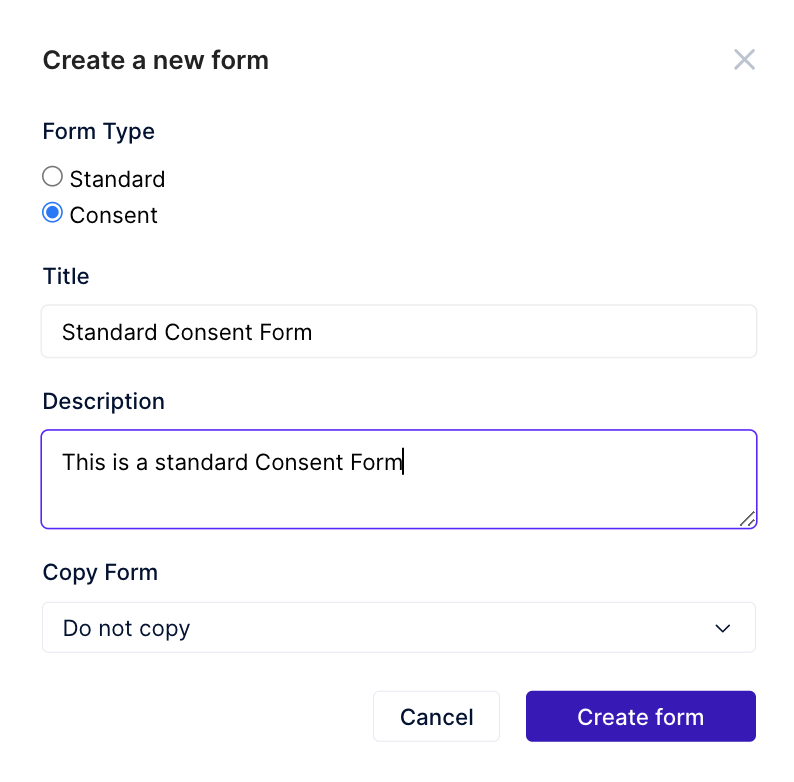
<div align="left"><img src="https://content.gitbook.com/content/T7fhyut5rrQHwe5QRGot/blobs/u8u3msUbJ33DYom48lvA/37037883058196" alt="" width="375"></div>
{% endstep %}
{% endstepper %}

Within the Form Builder, you'll notice that **three questions** have been added automatically; a Page Title, a Page Paragraph, and a Short Answer with a two way sync with the Email Panel Property. This can be modified, but an email question that syncs with the Email Panel Property **is required** to ensure that the Consent Form is attached to the panelist.

Now that the Consent Form has been built, you can attach the form to a Panel. To do so, navigate to the Panels tab, select "All Panels", and finally chose which Panel you would like to attach the form to.

![](https://content.gitbook.com/content/T7fhyut5rrQHwe5QRGot/blobs/HUUbYk0syGOX3leL2UbK/38083248128020)

From the Panel detail page, click "+ Add Consent Forms" and select the form you just created from the drop down. This will attach the Consent Form to the Panel.

![](https://content.gitbook.com/content/T7fhyut5rrQHwe5QRGot/blobs/BzQcPn6pBTeQQJWOgNoP/38083291586452)

{% hint style="info" %}
**Note:** If you are looking to attach a Signup Form, use the "+ Add Signup Forms" button above.
{% endhint %}

### When do panelists see consent forms?

Panelists may see consent forms at different times depending on how they were added to your Private Panels account. Refer to the table below to learn when consent forms are shown to panelists for each creation method:

{% hint style="info" %}
**Note:** Panelists always see the consent form tied to their respective panel. In Private Panels, consent forms are not tied to individual studies. If a panelist belongs to more than one panel, they must complete consent forms for every panel they're on.
{% endhint %}

| Panelist creation method     | Complete consent form          |
| ---------------------------- | ------------------------------ |
| **Submitted a sign-up form** | Immediately                    |
| **Imported via CSV**         | Upon first screener submission |
| **Imported via Salesforce**  | Upon first screener submission |
| **Imported via API**         | Upon first screener submission |

{% hint style="info" %}
**Note:** Private Panels was previously managed outside of Dscout, so you may see a different logo and URL in some places. If you have any questions, contact <support@dscout.com>.
{% endhint %}


---

# Agent Instructions
This documentation is published with GitBook. GitBook is the documentation platform designed so that both humans and AI agents can read, navigate, and reason over technical content effectively. Learn more at gitbook.com.

## Querying This Documentation
If you need additional information that is not directly available in this page, you can query the documentation dynamically by asking a question.

Perform an HTTP GET request on the current page URL with the `ask` query parameter, and the optional `goal` query parameter:

```
GET https://help.dscout.com/private-panels/panel-management/consent-forms.md?ask=<question>&goal=<endgoal>
```

`ask` is the immediate question: it should be specific, self-contained, and written in natural language.
`goal` is optional and describes the broader end goal you are ultimately trying to accomplish on behalf of the user. GitBook uses it to tailor the answer towards what is most useful for that goal.

The response will contain a direct answer to the question and relevant excerpts and sources from the documentation.

Use this mechanism when the answer is not explicitly present in the current page, you need clarification or additional context, or you want to retrieve related documentation sections.
