> For the complete documentation index, see [llms.txt](https://help.dscout.com/llms.txt). Markdown versions of documentation pages are available by appending `.md` to page URLs; this page is available as [Markdown](https://help.dscout.com/recruit-participants/what-are-dscout-screeners/screener-flow-for-bring-your-own-participants.md).
# Screener flow for bring-your-own participants
When recruiting your participants, you have several options for how to get those participants on to Dscout. In this article, we’ll be outlining how to onboard participants via invite-link screeners, but you can see links to other onboarding flows below:
* [**Diary study onboarding flow for first time participants (profile not required)**](/diary-studies/manage-a-diary-study/diary-study-onboarding-flow-for-first-time-participants-profile-not-required.md)
* [**Diary study onboarding flow for first time participants (profile required)**](/diary-studies/manage-a-diary-study/diary-study-onboarding-flow-for-first-time-participants-profile-required.md)
* [**First time participant flow in a desktop interview study**](/interview-studies/manage-an-interview-study/first-time-participant-flow-in-a-desktop-interview-study.md)
* [**First time participant flow in a mobile interview study**](/interview-studies/manage-an-interview-study/first-time-participant-flow-in-a-mobile-interview-study.md)
Once you have set up your screener and sent the [**screener webpage link**](/recruit-participants/what-are-dscout-screeners/screener-webpages.md) out to your participants, they’ll go through the following steps to get onboarded on to the Dscout platform:
## Participants access through the webpage
Participants will see a webpage with information about the screener. On this page, participants will submit their name and email to create a Dscout account. They will also be prompted to review the Scout Terms & Conditions and Privacy Policy and select the checkbox to indicate they agree to them. See a copy of the Scout Terms & Conditions & Privacy Policy [**here**](https://dscout.com/legal/scout-terms).

{% tabs %}
{% tab title="New User" %}
Participants whose email address has never been used to sign in to Dscout
Once participants select **Begin research study** on the public webpage, they will proceed to question 1 of the screener.
{% endtab %}
{% tab title="Returning User" %}
A participant whose email address has previously been used to sign in to Dscout:
Once participants select \*Continue\* on the Public Webpage they will be prompted to verify their email.
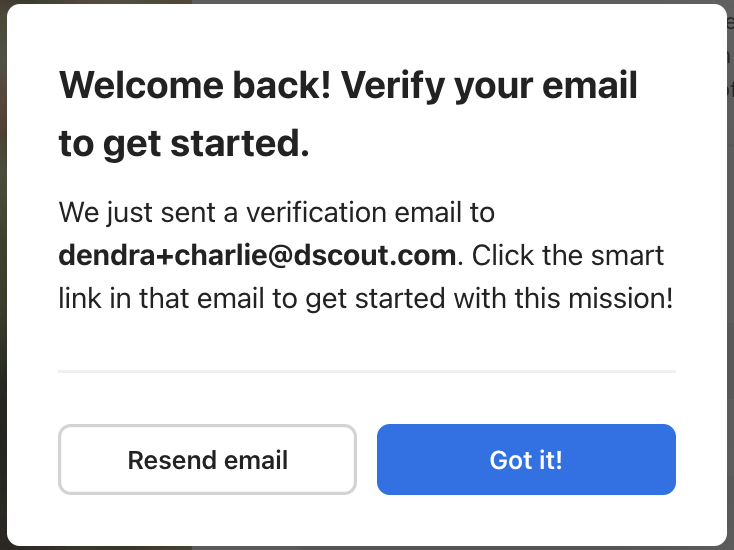 Participants will receive an email from [**participate@dscout.com**](mailto:participate@dscout.com) which contains the smart link. Once participants click the link in their email, they will be brought to Q1 of the screener.

{% endtab %}
{% endtabs %}
---
# Agent Instructions
This documentation is published with GitBook. GitBook is the documentation platform designed so that both humans and AI agents can read, navigate, and reason over technical content effectively. Learn more at gitbook.com.
## Querying This Documentation
If you need additional information that is not directly available in this page, you can query the documentation by asking a question.
Perform an HTTP GET request on the following URL with the `ask` and `goal` query parameters:
```
GET https://help.dscout.com/recruit-participants/what-are-dscout-screeners/screener-flow-for-bring-your-own-participants.md?ask=&goal=
```
`ask` is the immediate question: it should be specific, self-contained, and written in natural language.
`goal` is what the user is ultimately trying to achieve, the reason they need the answer. Sharing it helps GitBook give you a better, more relevant answer. A goal is most helpful when it describes the outcome the user wants rather than restating the question. For example, with `ask=how do I create an API token`, a goal like `automate deployments from our CI pipeline` lets GitBook tailor the answer to that use case.
The response will contain a direct answer to the question and relevant excerpts and sources from the documentation.
Use this mechanism when the answer is not explicitly present in the current page, you need clarification or additional context, or you want to retrieve related documentation sections.
Participants will receive an email from [**participate@dscout.com**](mailto:participate@dscout.com) which contains the smart link. Once participants click the link in their email, they will be brought to Q1 of the screener.

{% endtab %}
{% endtabs %}
---
# Agent Instructions
This documentation is published with GitBook. GitBook is the documentation platform designed so that both humans and AI agents can read, navigate, and reason over technical content effectively. Learn more at gitbook.com.
## Querying This Documentation
If you need additional information that is not directly available in this page, you can query the documentation by asking a question.
Perform an HTTP GET request on the following URL with the `ask` and `goal` query parameters:
```
GET https://help.dscout.com/recruit-participants/what-are-dscout-screeners/screener-flow-for-bring-your-own-participants.md?ask=&goal=
```
`ask` is the immediate question: it should be specific, self-contained, and written in natural language.
`goal` is what the user is ultimately trying to achieve, the reason they need the answer. Sharing it helps GitBook give you a better, more relevant answer. A goal is most helpful when it describes the outcome the user wants rather than restating the question. For example, with `ask=how do I create an API token`, a goal like `automate deployments from our CI pipeline` lets GitBook tailor the answer to that use case.
The response will contain a direct answer to the question and relevant excerpts and sources from the documentation.
Use this mechanism when the answer is not explicitly present in the current page, you need clarification or additional context, or you want to retrieve related documentation sections.